-
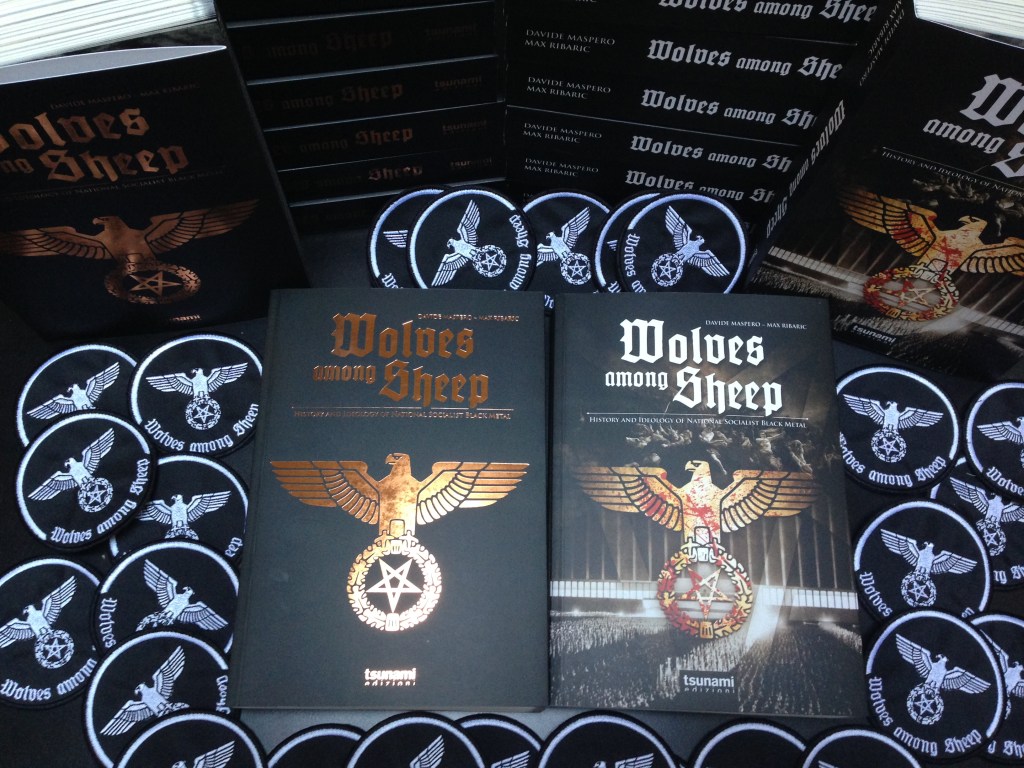
Interview for “Come Lupi Tra Le Pecore / Wolves among Sheep” (2015/2023)
by Davide Maspero and Max Ribaric
In the complex and ever-changing scenario of Nineties extreme metal, after the season of the arsons and once we entered that process of transition that would see the genre take two distinct directions – on one hand that of large-scale commercialization and on the other that of radicalization at all costs, taking the rudimentary ideological concepts expressed by the early representatives of the genre to the extreme – two characters strongly emerge, imprinting themselves on the collective imagination as the ultimate exacerbation of those anti-system concepts expressed by black metal: Varg Vikernes and Hendrik Möbus. Both with a blood-stained background, both with a charismatic personality and the protagonists of this genre’s musical history. Moreover, willing or unwilling, they are both considered NSBM’s putative fathers.
Today, Vikernes never misses an opportunity to emphasize the distance that separates him from anything that is even remotely associated to black metal, although banishing the ghosts of a past that has given him notoriety is not a simple task. Diametrically opposite is Möbus’ choice: once released from jail, he actively returned the the scene. Abandoning his career as a musician, he started managing Darker Than Black, which to this day is a a label strongly committed to digging into the underground in search of bands that are unfit for the mainstream music industry. Therefore, no one was better qualified than him to help us review the current state of the NSBM scene and the historical origins of this phenomenon.
Let’s take a step back to your activity as a musician. Absurd are widely considered as the pioneers of the soon to be called NSBM, and albums like Asgardsrei had a crucial impact on the scene, paving the way for other bands. How do you relate to this past and its legacy?
I am fine with it. Unlike many others from that era, I have never denounced who I am and what I have done. Black Metal was meant to be extreme music for extreme characters and it is a logical conclusion that “political extremism” can be included, too. If Black Metal shall be “more than music”, if it shall make an impact on the world beyond the realm of art – then “politics” is a means to this end, as a matter of course. Hence I have never drawn a line and said I, or Absurd for that matter, have to be “unpolitical” or whatever… Quite to the contrary, I think the only line can be drawn when it comes to “politically correct Black Metal”, because that’s nothing but an oxymoron.
The ideas and ideals that can be found in National Socialism, namely Social Darwinism and Individual Elitism, Aryan Supremacy and Anti-Judaism, Blood Mysticism and Neo-Paganism, among others, do suit Black Metal very well. Although I am not interested in “party politics” any longer, I do not deny that my world view remains the same more or less and that Black Metal is one medium for expressing me myself as well as a mirror that does reflect me myself, if you know what I mean…
During those years you also created Darker Than Black Records. In almost 20 years of activity it has become one of the most long-lasting labels focused on politically incorrect extreme metal, it’s been raided and shutdown by the police and was finally reborn in 2007. Not exactly the usual routine for a record label. What were your goals then and what are they now?
Well, I do prefer the old-fashioned position of a patron of arts. Maybe you have noticed that I do sign and produce “newcomers” first and foremost. I want artists and music bands to express their innermost creativity in an environment where they do not need to compromise their artistic vision. Many record companies and music magazines want Black Metal to be castrated and domesticated for the sake of improved “marketability”. From my point of view, that’s anathema to the true and original spirit of Black Metal. D.T.B. Records stands for the freedom of art and expression. There shall be no restrictions imposed on Black Metal.
Contrary to popular belief, I do not necessarily release “NSBM”-bands only. If you look at the release roster and schedule for D.T.B. Records, then you will find all sorts of Black-/Pagan Metal there. No band I am working with has to swear allegiance to my own, private worldview. They are free to express themselves how it suits them best. Needless to say, I draw a line where any band would advocate ideas diametrically opposed to the ones I have subscribed to myself. In all the history of the record label, it has never, ever happened that a band and I have had a falling-out over “politics”, though.
And what about your current relationship with the authorities regarding DTB’s activities?
I am sure they keep monitoring me, and what I am doing. Well, that’s one brave new world we are living in, is it not? A music compact disc can be more dangerous than, say, one kilogram of TNT. Words as weapons. Music of mass destruction. For as long as nobody does disturb my circles, I could not care less for what others, the “authorities” included, do think, say or write about D.T.B. Records, though.
How do you see NSBM today and which differences do you see between the current situation and the years when bands like Funeral/Kristallnacht, Absurd or bands from the Temple of Fullmoon moved their first steps?
Well, you will be hard-pressed to find any Black Metal-band that openly admits to being “NSBM” nowadays. It is only Der Stürmer and Wolfnacht, both from Hellas, that have no problem whatsoever with saying so. Many others, even though they are sympathizers of National Socialism, will insist that their lyrics are about war, genocide, oppression, what-have-you… but not about “politics”, as a matter of course. So, there’s a difference: In the late 1990ties, many bands who were said (and said so themselves!) to be “NSBM” did not bother to make any “political statement” whatsoever, but today you have bands making “political statements” that are hell-bent on avoiding the “NSBM”-tag for themselves nonetheless. Alas, that’s not even a “wolf in sheep’s clothing”-approach but cowardice and opportunism, plain and simple. You want to play with fire but you don’t want to get burnt. Well, I am not here to blame anyone, though. To each his own, and I am in a position where my “public reputation” could hardly suffer any more regardless of how I think and feel about National Socialism myself, for instance.
It’s a widespread opinion that NSBM is an extremization of black metal, triggered by the commercialization of the genre, which in turn led to the loss of its primary subversive force. Do you agree with this idea? In this sense could we say that NSBM retrieves BM’s original spirit?
Actually, that’s a minority opinion for all I know. However, you hit the nail right on the head! The rise of “NSBM” started at the same time when Black Metal experienced a massive commercial exploitation, in the late 1990ties. All of a sudden, the bloodshed caused by Black Metal and the ashes of torched churches left behind did not make a difference any longer, because the “music business”, in as far as Metal music is concerned, eventually realized you can move tens of thousands of albums of one Black Metal-band. Yes of course, the band would need to be less extreme, less violent and less militant for appealing to an even broader audience. Plenty of bands, in particular from Scandinavia, were willing to sacrifice whatever radical zealotry there was in Black Metal for the sake of “fame” and “money”. Needless to say, this decline of Black Metal has sparked a new wave of radicalization and extremism among the underground scene.
To some bands, the last resort that could effectively withstand the commercialization of Black Metal was to swear loyalty to National Socialism – if not in lyrics and “band image”, then in interviews and statements at the very least. In Western society, there is next to nothing left that a majority of people truly abhor and won’t ever tolerate no matter what. You can blaspheme Jesus Christ and hail Satan, so what? Nobody gives a fuck. You can talk about all sorts of sexual depravity, and they ask for more. In our day and age, it is only National Socialism that shuts all doors and turns all backs on you. Since Black Metal thrives best in isolation and self-induced hatred against the modern world, resorting to National Socialism as a means to keep untainted the pure essence of the genuine spirit of this particular genre ought not come as a surprise, actually.
Compared to the Nineties, NSBM seems to be less widespread in Western Europe, while it is very popular in the former Soviet territories, also in the form of pagan metal with racial implications. Do you think the succes of the genre in those areas is only due to the years spent under the Communist regime or could there be other reasons?
Well, if you travel to Russia or Ukraine, then you will experience a lot of sympathy for National Socialism among the young people. Not among the elders who still remember World War 2, but the generation of their grandsons and –daughters, and especially their children, does have a positive perception of National Socialism actually. They have witnessed, or have been told by their parents, how Bolshevism imploded all by itself and left nothing but economic disaster and spiritual desolation behind. Whereas National Socialism was a vibrant and vital ideology that challenged the world, and thus the world needed to combine the strength of numberless nations to defeat and to eventually crush National Socialism in Germany and elsewhere. That’s one reason why National Socialism is so popular in East Europe.
If there are “smartasses” over here who belittle this popularity and who call it nuts, because the “Nazis wanted to conquer, to enslave and to kill alls Slavs”, then it shows they, not the young folks over there, have no clue of history but keep parroting the propaganda hostile to National Socialism. Be that as it may, since you wondered why you have not so many obvious “NSBM”-bands in West Europe: You have to consider the legal situation in many countries, be them Germany or France or Benelux or Austria… in each one does exist “thought crime”-legislation that effectively outlaws any and all “glorification of National Socialism”. If a band does not want to be prosecuted, fined or even jailed, then they will surely attempt to “fly under the radar” so to speak. Sometimes it works, other times it does not.
As it happened before with black metal, NSBM gained fame and it spread from Central and South America to far Eastern Russia and Southeast Asia. What’s your opinion on the large scale diffusion of the genre?
Well, I will respectfully quote David Myatt in this regard: «With the defeat of Germany and its allies in the First Zionist War, National-Socialism was purified, emerging as a complete way of life, centered around honour, loyalty and duty. The political compromises needed to achieve power were gone, as were the supporters who did not understand or live up to the ideals of National-Socialism. The essence emerged as the shell covering the essence was destroyed in the crucible of that war. People who have described this essence include Savitri Devi, Miguel Serrano, and Leon Degrelle. Since we now consciously understand this essence, it is possible to create – and only now possible to create – a genuine National-Socialist society. This would be an entirely new type of society and while the inspiration would be National-Socialist Germany, it would in many ways be very different, although it would manifest the same ethos, the same ideals».
That being said, I do not believe National Socialism in general and “NSBM” in particular ought to be limited to, say, Germany or European countries. However, the racial component cannot be faded out completely. If mongrels or Jews would be playing “NSBM”, then I’d consider this a really odd choice of genre for any of them. Since National Socialism, and thus “NSBM” too, is about Blood (= Descent) and Soil (= Origin) first and foremost, you would have to relate to this tradition in one way or another or else it is out of question you do realize – much less, comprehend – what this ideology is all about.
Today, the NSBM label seems to include various ideas: paganism, white supremacism, social darwinism, Traditionalism, Nazi mysticism and all types of nationalism. According to you, are there any “requirements” that define a band as NSBM? Considering the variety of themes presented by such bands, does the prefix NS still make sense?
There’s only one requirement I can think of right now: Namely, a band has to say they are “NSBM” to begin with. If you just look at the private worldview of musicians, then you could rightfully say Burzum too is “NSBM” even though Varg Vikernes would certainly disagree with this assessment, because Burzum is not about “politics”. However, you have plenty bands with obvious references to World War 2 or to NS-Germany that still deny to be “NSBM” or to be “political” at all. Be that as it may, the prefix NS does make sense now as before. It’s like a badge of honour; it proves you are at war with the powers-that-be while all alone in a hostile world.
The growing “political threat” has also brought heavy metal in the sights of antifa organizations that started to hinder certain bands/events. Is it a problem that concerns Germany too?
Yes, we have similar problems in Germany but truth be told, I do not deem it negative if Black Metal is considered to be a “menace to society” and dealt with accordingly. So-called “Antifa” is making much noise over Black Metal and many bands, even the popular ones signed to major record labels, encounter problems due to a “guilt by association”. That’s nothing to be deplored, though. A music genre so firmly opposed to the modern world and each and everything that does uphold the status quo, how could it be less than marginalized and boycotted by the “mainstream society”, I do wonder? How the “politically correct” ones react to Black Metal, all of their revulsion and antagonism, that’s the way this music genre, the bands and the fans alike, ought to be dealt with, actually.
I would only be concerned if it was the other way around, with Black Metal being widely tolerated and absorbed by “mainstream society”. That would prove this music genre lost its edge, and thus the raison d’être too. For all I care, this must never happen. And for as long as I am here, running D.T.B. Records among others, I will see to it that Black Metal remains a genuine counter-culture meant to challenge, and to ultimately overcome, the reality we are forced to live in.
What happened to Absurd and why there are now 2 versions of the band?
Well, there is only one band as far as I am concerned. You surely know that I was a founding member of Absurd back in 1992, and that the only reason why I couldn’t continue with the band was that I left Germany and went into hiding in the USA, end of 1999. Two years later my brother Wolf came up with the idea of reforming Absurd with a completely new line-up, with him being the vocalist, and I have approved of this idea and gave it my public blessing, so to speak. That’s how Absurd kept going until 2012, when this line-up played their final concert and after their last studio recordings taking place in 2008, and the band ceased to exist in all but name.
In 2017, Wolf explained to Alexey of Militant Zone that he’s done with Absurd, and with doing any music in general. That’s when I decided to return to active duty in Absurd, by taking over vocals and adding new members to the line-up. We have played a few concerts, in Ukraine, Italy, Finland and France, and started working on new recordings subsequently. In 2022 we have released the sixth and new full-length album of Absurd, “Schwarze Bande.
In the meantime, an ex-member of Absurd used a studio session for another band in 2019 to record a few songs that were later released under Absurd as well, but that’s all there is to it. Hence, there is only one Absurd headed by the sole remaining founding member and that’s me. Concerning the biography of Absurd, in particular when it comes to changes in the line-up, the official website http://www.hordeabsurd.com can provide detailed insight to anyone who cares. Last but not least, Absurd are currently working on new songs and more concerts might happen too.
NSBM (or we could say radical black metal, to avoid the strict NS category) saw an increasing popularity in these last 10 years. Bands like Goatmoon or Nokturnal Mortum gained a lot of attention even besides the NSBM milieu. Events like Hot Shower and, especially, Asgardsrei brought the festival experience to the public. Besides the covid/war stop, what’s your thought on the current status of the genre?
It’s simply about cause and effect, action and reaction. First of all, you need to consider the broader context: Although the loonie Left in the West pretends to be in opposition to a “racist” state and “bigot” society, it is absolutely self-evident that the mainstream in politics, culture and arts has gone full-blown “woke”. From the heads of the state via the global corporations to the entertainment and music industry, everyone is pushing a “woke” agenda of identity politics, gender theory and cultural marxism.
If you subscribe to the same agenda, then you are 100% mainstream. There is zero rebellion in your words and no revolt in what you do, either. You are just one more cog in the wheel, period. However, this can’t be reconciled with the self-image of a subculture which is supposed to be anything but mainstream. Hence, the more you forcibly align Black Metal to the mainstream the more you will have bands and fans in this scene start pushing back, and their gravitation towards radical (i.e. non-conforming) Black Metal comes as the pendulum swings. With that being said, there are three specific reasons why this sort of Black Metal enjoys an increasing popularity.
- The loonie Left and their “guilt by association” that keeps expanding the definition of who’s radical Black Metal, with many bands and musicians suddenly considered “sketchy” even though there is nothing in their music and lyrics to indicate any of that. However, they have fans who are now less inclined to stay away from radical Black Metal, because if the bands they already listen to are supposed to be “sketchy” why not start listening to other “sketchy” bands too?
- The musical merits of radical Black Metal, which have vastly improved during the last couple of years and can’t be denied even by their most rabid critics. There are numberless “Sketch-free alternatives to band XY?”-threads on Reddit, for instance. People there keep looking for “safe” and “woke” substitutes to NSBM- and other radical / “sketchy” bands, because they yearn to listen to such bands based on the music but can’t deal with the lyrics or concepts. Even though they oppose said bands based on ideological grounds, they acknowledge that their music is just great and right up their alley. It might be true that painting a swastika on your album cover might get your band attention, but if you want to get fans your music must be good. And some of the radical Black Metal-bands are top tier in the genre, with selling tens of thousands of records also to people who just appreciate their music but don’t care about the lyrics and image.
- The releases of radical Black Metal bands are widely available and easily accessible, even though YouTube and Bandcamp go to great lengths for deplatforming their music. If you go shopping at some of the biggest online vendors for extreme Metal, then you will inevitably come across a vast selection of all sorts of records from radical Black Metal to NSBM. Take Osmose Productions from France, for instance. Once upon a time, Hervé said he opposes any fascism in Black Metal and when Marduk recorded their “Panzerdivision Marduk”-album for Osmose, the original cover showing a German Tiger battletank from World War 2 was replaced by the photo of a modern tank from the Swedish army (also it was said that the band wasn’t aware of this until the CD was released) for not upsetting any distributors in Germany; but many years later when Osmose started to work with bands like Nokturnal Mortum and the editors of German Metal press advised Hervé to stop doing that or else they wouldn’t print his advertisement anymore, he told them to fuck off and from this point on he just wouldn’t care about Black Metal said to be “sketchy” or not anymore. Now you can buy pretty much all the releases of radical Black Metal from Osmose too.
Contrary to the increasing popularity of the records released by radical Black Metal and NSBM-bands, the situation for live gigs has sharply declined since the start of Covid-related restrictions in Europe and elsewhere. For the powers-that-be it’s impossible to keep music from circulating once it was released, but it’s perfectly possible to cancel the live performance of this music if they know the date and place in advance.
The Asgardsrei festival was always singular, because it was a public event in a major city that could be easily visited by tourists from all over the world, but now this ain’t possible anymore and you can’t pull off the same kind of festival at any other place in Europe or North America, either. Hot Shower already was much more clandestine, and smaller events were even less advertised and thus remained confined to a local audience only. Organizers and bands must go to great lengths to make gigs happen without paying extra, because the tighter the security and secrecy the smaller the audience and revenue.
Furthermore, the local authorities also double down on their efforts to don’t let such gigs take place, at all. For instance, already in 2019 the Federal Police of Germany has seized my passport for one weekend and they didn’t let me fly to Kiew, because they said I want to attend a “Nazi gathering” there and thus they issued a worldwide travel ban for me. Now they keep doing the same to a lot more people whenever there is a concert or other event abroad and they presume that you might want to go there (either as band or as guest).
I don’t think that there comes the time when we have zero gigs of radical Black Metal and NSBM-bands anywhere, but at least in Europe and North America we are unlikely to see big festivals with several hundreds or thousands of people anymore.
In recent years, the pressures of antifa organizations on black metal (especially in the USA) have increased. But many “regular” listeners are getting tired of cancel culture and politically correct. Do you think this situation could create a rift in the public, pushing people towards more radical ideas since there is no longer a gray area in between?
Yes of course, that is already happening and the loonie Left, spearheaded by so-called “Antifa”, keeps ceaselessly erasing any “grey zone” between the radical fringe and the self-proclaimed “unpolitical” main body of Black Metal. I’ve always reminded everyone, who believed “Antifa” would “just deal with the Nazis in Metal and leave everyone else alone”, that they follow a strict “with us or against us”-modus operandi and thus they will never cease targeting and hounding bands unless musicians actually swear allegiance to the “woke” agenda. It ain’t enough to say “Our band is not about politics!”, because for “Antifa”, everything is politics. Identity politics, minority politics, gender politics, you-name-it.
Heavy Metal is a deeply conservative genre, it’s not “progressive” at all (just look at Manowar and you know what I am talking about). Even if there’s no NSBM anywhere to be found, there’s still so much more about Metal that offends “Antifa” and will provide them with ample reason to push their agenda in the Metal-scene no matter what. They are ignorant of any traditions and the history of this genre, because they are outsiders and strangers to Black Metal.
Quite a few bands in this particular scene, especially the more popular ones, are comfortable with fence sitting. They enjoy their private meetings and talks with the “bad guys” of the scene but they will never come out of the closet and admit that they are on friendly terms with someone deemed “Nazi”. If “Antifa” keeps pushing them off the fence and forces them to pick a side and stand their ground, all the better. Once bands will be so pissed off at Antifa that they ask their fans to don’t affiliate with anyone or anything “leftist”, we can step in and reach out and take over. “Antifa” is so much better at rallying hitherto unpolitical Metal-fans behind our banner and to our cause than what we could accomplish ourselves, just let them bring it on and keep it up for all I care! For every concert of Marduk, Taake, Deströyer 666, etc., that they manage to get cancelled, we’ll get a hundred more fans and followers of radical Black Metal and NSBM in return.
DTB was among the first label to catch the so called magick metal phenomenon, with Black Magick SS, Edelweiss and so on. What’s your thought on this subgenre? Do you think this kind of approach can “normalize” NS symbols and maybe bring new people to this kind of music/ideas?
I have started to release Black Magick SS long before there was any “Magick Metal”-trend and later I have worked with some other bands playing a similar style of music, because I liked what they did with their music and wanted this to be properly released and distributed. However, to me it was always obvious that any symbols and references to NS on their records were not supposed to be a political statement, but it’s rather a tongue-in-cheek gimmick for the sake of controversy and notoriety. There’s the people who are sounding alarm bells when they see a SS-Totenkopf on display and then there are the people who keep laughing it off, because this Totenkopf also shows a witch’s hat and looks decidedly funny. Either way, you got people talking about your band and buying your records, and that’s all that matters to a whole lot of bands obviously. A CD of Black Magick SS is most likely not helping any more to “normalize” NS symbols than, say, “Inglourious Basterds” by Quentin Tarantino does. It’s just entertainment to most people, I’d say. Those who want to see the NS in “Magick Metal” will keep feeling vindicated by certain symbols and similar references, and those who don’t want to see any NS in it will find plenty reasons why none of it must be taken seriously.
-
The Prophet of Green Eugenics: Kaarlo Pentti Linkola (1932 – 2020)
The end is nigh, now more than ever. The year 2019 was all about the “climate crisis”, in Western Europe at the very least. Every Friday, in any major city of Western Europe, you could see a pilgrimage of schoolchildren gathering and solemnly listening to a young female preacher from Sweden, who’s proclaiming the inevitable destruction of life on earth unless everyone in Europe and North America atones for their ecological transgressions and vows to de-carbonize the Western civilization instantly. The „Fridays for Future“-movement, along with the more radical offshoots like „Extinction Rebellion“, have caused a considerable media frenzy yielding political clout by the so-called Green Party and leftist political players in the national parliaments as well as the European Union. With the elections for the European Parliament in May 2019, the apocalyptic narrative concocted by “Fridays for Future” was believed to be decisive for victory or defeat at the ballot box. The Green Party and their leftist associates promised to make ecology their top priority and that helped them get many votes accordingly, whereas the other political parties were punished at the polls for sitting on their hands instead of saving the world, or worse, that they have been ignorant and doubted the climate change all along. Conservative lawmakers are indeed sceptic of the fancy idea that by reducing CO2-Emission in one single nation we could have any impact whatsoever on the world climate. Why impairing domestic economy, with entire industries shutting down and unemployment skyrocketing, when it won’t make any difference to the world climate? However, for the many new adepts of so-called “deep ecology”, our departure from fossil energy is long overdue. They predict a point of no return, with global warming exceeding 2 degree Celsius from here on, when the eco-system of the entire planet will collapse and the extinction of life on earth becomes a real scenario.
Well, with life on earth being as old as 3 billion years, there has never been a stable world climate that wouldn’t have changed profoundly at some point. We know of many periods of global warming and cooling but still, life prevails because it adapts and evolves. I have no doubt that there will be life on earth until the sun expands and makes earth inhabitable, but if this life will always include the human species remains to be seen.
In the Glare of the Burning Rainforest
Leftist political parties have become the patrons and cheerleaders of the new Green grassroots movement, willingly subscribing to the narrative of man-made climate change. Their political opponents rather support the climate change-skeptics among the academics, who don’t question that there is any climate change – because that is what climate did and keeps doing, it changes – but that this change is actually and exclusively man-made. In their opinion, which does have scientific merits indeed, humankind can’t be the prime cause of climate change, because empirical data shows periodic ups and downs of median temperatures in the course of human history, also at a time when men were few and there was no technology to speak of. Hence the global warming of the last decades could perfectly be a natural phenomenon unrelated to any human activity. Be that as it may, but this opinion is anything but popular nowadays. If you deny man-made climate change, then in the eyes of the “Fridays for Future”-disciples you commit heresy that will render you unworthy of participation on political debate.
We must not live in denial, I say. The world climate does change, indeed, and the adverse side-effects of global warming can be experienced in everyone’s daily life already. I have no doubts that there is a human factor to climate change, but it’d be wrong to point a finger at the Western man and hold his industrial society accountable. Quite to the contrary, Western engineering and technological progress made our countries so much greener and cleaner in the last 50 years or so, a fact that is best observed by comparing Europe to any backward place on earth. It is also an empiric matter of fact that in Europe, many species of flora and fauna are prospering instead of perishing. If there’s something in our own countries that is adversely affecting the eco-system, then it surely is neither our industry and technology nor our traffic and infrastructure, but our mechanized agriculture and factory farming which no longer serve self-sufficiency. The food thereby produced is not needed by us but required to increase the world food supply. Not so long ago the images of rainforest fires made the news in Europe and it was understood that the forest burns for the sake of growing soy, a vegetable that is used as animal feed in our factory farming. What was not equally acknowledged is the fact that the meat coming from the same animal farms goes into export to many countries all over the world. How can we deplore the blazing destruction of the Amazon rainforest but stay oblivious to the numberless people craving for the food coming from the ashes of the forest fires? If there’d be fewer people on earth, then factory farming would most likely not exist and the rainforest would not have to burn, either.
Environmentalism is not a leftist agenda
The political Left is not, and never was, genuinely concerned with environmentalism. There never was, or is, a leftist regime that addressed animal rights or nature protection. In the socialist countries with a state-owned industry, pollution of air and water by industrial poisons was commonplace. You were not supposed to talk about any of that lest you’d become an enemy of the state. The political Left stays ignorant of ecology to this day, because their core ideology is anthropinism. They support “Fridays for Future” for no reason other but to inject criticism of the political and economic system into this movement. The Green Party, in Germany at least, was originally founded by conservationists in the tradition of the early 20th century-youth movements, many of which wished to restore – quite an idealistic and romantic notion, no doubt – a harmony of man and nature whereas their leftist counterparts were busy toppling the old order in favor of a new world for a new man. The Green Party has come a long way of internal struggling and purging until it eventually emerged as another leftist political party. Although the Green Party would still speak of animal rights, renewable energy and nature protection, their political agenda is now the very same identity politics that you can find anywhere on the political Left these days. Hence the Green Party too advocates “open borders” and “refugees welcome”. This political party is now obsessed with their definition of “climate refugees”. That’s the migrant coming from a country devastated by climate change, and we have the duty to welcome him because it’s our industrial society responsible for melting ice and rising waters. Unsurprisingly, this narrative of Western man wreaking havoc on the climate of faraway countries is the new sequel to the old story of Western man colonizing and exploiting Africa, and equally backward places, for the last 500 years. The “White guilt”-complex is so deeply entrenched in Western culture that the kids and teenagers joining “Fridays for Future” just can’t wait to atone for the sins of their fathers. As always with a narrative concocted by leftist ideologues and demagogues, this is a hoax designed to seize political power, and nothing else.
No noble savage anywhere
There never was any age in human history when man did not interfere in the eco-system for the sake of advancing technological progress, and thus, raising his living standard. After the Stone Age, when man had the means and tools to start agriculture and abandon the life of nomads, his interference in the environment started to show: Man has cut down the forests to have space for cultivating crops and cattle; man built dwellings made of wood and stone; man decimated predators and domesticated other animals whenever they suited his needs. Do you believe that anywhere in Europe – save for a few remote areas always void of human habitation – is a place that wasn’t cultivated by man at some point in history? The forests we have in Germany, for instance: Almost all of them are man-made in one way or another. Man began cutting down the forests in the middle ages, just to see them grow back during the prolonged periods of war and pestilence, and then he went to cut them down all over again. When he started with forestry in earnest, he planted trees that would grow fast and yield a good timber harvest. That’s why there are so many monocultural forests in Germany. Or look at Iceland, for instance – we know it as a place void of trees but prior to the arrival of the first settlers from Norway, almost half of this island was covered by forests and it took man only two centuries to turn Iceland into the barren landscape we can see ever since. Yet man survived and life persisted. Man has interfered with the eco-system long before the advent of the Industrial Age, because his survival depends on taming the wild and unpredictable forces of nature.
The indigenous peoples so much admired for their presumably “harmonious co-existence” with nature? Well, they just lacked the means and tools to advance beyond that primal existence of hunters and gatherers. Once they too learned how to manipulate the environment to their own benefit, they never hesitated to replace the flintstone with iron and the arrow with the bullet. The age of blissful innocence can only exist when there is no man, at all. However, nature can and does adapt to the ways of man. And man can and does become mindful of the fragile eco-system that he still struggles to comprehend, but that he understands is the only sphere of life anywhere in the vast cosmos known to us. We in the Western World have come a long way from the mindless exploitation of nature to the point when we care so much for the environment that now we have legislation protecting wildlife, regulating forestry, and penalizing animal abuse. Never in human history has any high civilization been more considerate of ecological issues than modern industrial society. And do you know what without a doubt must be considered the most profound contribution to our green conscience and consciousness? Why, it’s the declining birthrate in Western countries, of course!
Quality vs. Quantity
I am aware that in our movement, the declining birthrate of Western women keeps setting off alarm bells. We uphold the traditional family image of the father, the mother and their many children; and yet we can’t deny that the reality in our countries looks so differently. Our movement feels very concerned about the demographic decline in Europe, and family values are promoted, with much ardor at that, as integral part of our political agenda. We are observant of the alien cultures where the women do have a much higher birthrate now as before, and it is our conclusion that their offspring could replace ours in a not so distant future. Although I am sympathetic to such sentiments, I believe we must not engage in a demographic arms race with any other race or nation in the world. Our Western civilization, with the high degree of industrialization, mechanization, and digitalization, requires few but highly trained workforce. Quality trumps quantity, as usual. That can be said about mechanized warfare too, by the way. One argument made for a higher birthrate is the fear that we could become defenseless if we have less men fit for military service. But if manpower would be so decisive in a modern-day war, then I wonder why the Arabs, for instance, can’t drive the Jews from Israel back into the sea even though they are outnumbering them easily. They can’t, because their enemy keeps the military supremacy using advanced weaponry not available to anyone else. Israel, just like South Africa before, perfectly proves that an ethnic minority can deter another ethnic majority with just the right show of force. But even though we must never become a powerless minority in our own countries, we still don’t need an inflated population in Europe anymore.
Once upon a time, the nomadic and tribal society always struggled to survive. Any newborn would make this society less vulnerable to extinction. During the middle ages in Europe, the population started to outpace the food production and new ways to deal with excess offspring had to be found; the girls could be married off but the boys, other than the firstborn that is, could either be delivered to one of the many Christian monasteries or sent away to the colonies. In other cultures where that was not possible, as it is known from the isolated Maya and Aztec civilizations of Central America for instance, the religious rite of human sacrifice was introduced. The sacrifice of infants and virgin girls would cull the population to never grow beyond the limits of food production.
Now that we live in the industrial civilization, we have much more sophisticated means of population control at our disposal. Why would we need a growing population, anyway? Western man got a much longer life expectancy compared to previous generations, while at the same time artificial intelligence, automation and robotization make life management so much easier than ever before. Those in favor of mass immigration keep saying that we need to import workforce to our countries lest our declining and aging society will experience a setback to our high living standard, but this is a moot argument considering the rapid pace at which artificial intelligence and robots occupy the jobs formerly done by humans. The migrants, almost all of them illegal aliens, coming from Africa and the Middle East to Europe are not fit to contribute to our economy, because many have zero school education to the point they can’t read and write, either. They end up as the dregs of society, and that’s exactly what they shall be according to leftist demagogues. Their agenda of re-distributing the wealth of a nation can’t have the desired effect if there’s no one in society who is poor and feels disadvantaged. Behind the slogans of “open borders”, “no nations” and “refugees welcome” is the age-old Marxist vision of the leftist rabble-rouser stirring up social unrest until the Lumpenproletariat takes to the streets and chases the powers-that-be away for a leftist regime taking over.
Battle of the Youth Bulge
We live in wealthy nations that are immensely attractive to people living in far less fortunate conditions, especially in Africa with tribal societies engulfed in endless civil war and smothered by cancerous corruption. However, the migration of millions of them, on their way up North, is caused neither by economics nor by the climate change in the first place. The so-called youth bulge puts an increasing pressure on the population of countries in Africa and the Middle East. Empirical academic research has linked an excess in young adult male population with a rise of social unrest, war and terrorism in the affected societies. A large population of adolescents entering labor force and electorate strains at the seams of the economy and polity, which were designed for smaller populations. If the society can’t cope with this challenge quick enough, by providing new opportunities of employment and political participation, then the youth bulge will likely upset the social and political order. This is exactly what happened in the so-called “Arab Spring” across North Africa and the Middle East, since 2011, because in this region we have countries with 50% and more of the population being younger than 30 years old. Left without any perspective in their homelands, this generation not only went to war turning their countries into failed states, but they also started migrating to Europe, in a kind of reverse colonialism.
Centuries ago, the Europeans turned South, exporting their own youth bulge to remote countries and continents, but now we can experience first-hand how history repeats itself under different conditions. Considering how the youth bulge in North as well as sub-Saharan Africa keeps growing at a fast pace and with no end in sight, migration to Europe is unlikely to stop unless we’d have a closed border turning the continent into a fortress.
Malthusian limits of Population Growth
Time and again we are reminded of the dwindling non-renewable resources exploited by industrial civilization and how that will rather sooner than later jeopardize the survival of mankind, but it’s kind of weird how overpopulation is almost never an issue in the political and medial debate about “The Limits of Growth”. If addressed by anyone at all, then in a rather dismissive manner: If more people on earth could enjoy the Western way of life, then their birthrate would drop by default. Hence it is predicted by the United Nations that after the year 2100, the human population growth – then believed to be exceeding 11 billion by conservative estimates – will peak and start levelling off subsequently, with less humans born in every coming generation. Until then, we are said to be well-equipped to feed an ever-growing human population by the means of industrial agriculture and factory farming. Just a few months ago, in July 2019, it was reported that European Union agri-food exports reached €13.07 billion. In a market economy, there will be a supply for as long as there is a demand. Exporting food to the Third World promises profit, and with more food readily available at the world market the global population can keep growing. Hence I am not that confident about the official prediction of so-called United Nations-“experts” concerning the growth of mankind in future. What if they are wrong? After the year 2100, mankind will know but then it could be far too late to do anything about it. Should we not be mindful and try to manage the growth of human population right here and now? We put so much effort in keeping global temperature from rising more than 2 degree Celsius, but what is being done about keeping human population growth under control?
The notion of overpopulation spelling the doom for civilization is anything but new. It was in 1798 when Thomas Malthus wrote about it in his “Essay on the Principle of Population”. His core theory was suggesting that man must be mindful of preventive population check, because if population growth remains uncontrolled, then “sickly seasons, epidemics, pestilence, and plague advance in terrific array, and sweep off their thousands and tens of thousands. Should success be still incomplete, gigantic inevitable famine stalks in the rear, and with one mighty blow levels the population with the food of the world”. This is known as the “Malthusian spectre” haunting mankind; when population growth outpaces agricultural production. It was later said that history proved Malthus wrong, because mechanized agriculture combined with industrial fertilizers produced a dramatic increase in productivity of agriculture, thus expanding the world’s food supply while lowering food prices. It is further predicted that world food production will be in excess of the needs of the human population by the year 2030. Man managed to outwit the constraints of natural growth, because he kept inventing and developing new technologies that made him far less vulnerable to the hazards of nature threatening his very survival. However, it is not true that Malthus’ warning could be dismissed so easily. In modern times, the two most densely populated countries are China and India. In both countries it was understood that without checks and balances put on the demographic growth, their ascent from pre-industrial agricultural backward nations to economic powerhouses of industrial society would simply be impossible. A starving and dying population can’t work in the industry, obviously. China adopted a strict one child-policy early on, which was partially revoked only now, whereas India offered incentives for men and women to get sterilized at special clinics. In both nations it was understood that children can be something else but a blessing for their family; if there are too many of them, they can also become a burden on society. Without their efforts on keeping their population growth in check, it would be quite unlikely that China and India made a major leap, in less than 50 years, from being underdeveloped countries to become serious competitors to Europe and the United States of America. They were mindful of Malthus’ warning, and rightly so.
Igniting the Population Bomb
Fifty years ago, in 1968, Stanford University Professor Paul R. Ehrlich and his wife published the best-selling book “The Population Bomb”. They described a not-so-distant future in which growing human population places escalating strains on all aspects of the natural world. Global famine is inevitable, causing hundreds of millions of people to starve to death. Although the predictions made in “The Population Bomb” did not come to pass, the Ehrlichs’ maintain that their general argument remains intact. Indeed, it should be hard to deny that the unchecked growth of human population could proceed without any repercussions on earths’ eco-system. The so-called “ecological footprint” of man is not only about consumption but about waste disposal too. In Western countries we go the extra mile to cope with the waste that’s related to our consumer behavior, but in less developed countries you have waste littering the landscape and contaminating the waters. Another part of the “ecological footprint” is the mass-consumption of agricultural and farming products. In the West we are eating too much meat, indeed, but globally, too many people eat just too much of anything. If the climate change is indeed man-made, then without a doubt the environmental side-effects of mechanized agriculture and factory farming, which we would neither need nor have in this magnitude if it wasn’t for the incessantly growing world population, have to do with it. If we talk of CO2-emissions contributing to global warming, then we must consider the millions of livestock bred and raised and slaughtered to feed mankind. It remains a mystery to me how anyone can call for a boycott of factory farming without addressing the problem of global overpopulation at the same time. The population bomb will go off as soon as there will be significantly less instead of more exports of agricultural and farming products, from Europe and North America to the rest of the world.
The Fisherman-Prophet
The “The Population Bomb” received much criticism from the political Left, which insisted that the real issue was one of distribution of resources rather than of overpopulation. They worried that Ehrlich’s work could be used to justify genocide, oppression of minorities or even a return to eugenics. At this point, the Finnish philosopher Kaarlo Pentti Linkola enters the picture. Linkola is a Finnish ornithologist and conservationist. He was born in Helsinki in 1932; his father was rector of the university of Helsinki and his grandfather was chancellor there too. Linkola never aspired to an academic career of his own, though. He donated much of his family inheritance to the Finnish Natural Heritage Foundation, an NGO created by him to preserve the forest for the Finnish society. Linkola lives in a wooden cabin in rural Finland, where he spends his time as fisherman but every now and then, he is writing letters and essays outlining his philosophy on life and earth. Almost a dozen books with his writings were published in Finnish, but there is one English compilation of some of his articles that introduced him to a worldwide audience. It is safe to say that his writings would go unnoticed if Linkola would keep talking about birds instead of humans.
According to Linkola, man must return and be confined to a much smaller place in the eco-system. To this end, human population must be reduced. Capitalism and free market economy, with its pursuit of unceasing economic growth replacing subsistence economy, must end. Not only the fossil but any energy, whether it’s coming from fossil fuel or renewable sources, must not be generated or used anymore. The democracy as well as civil liberties, must be abolished and man shall be governed by an autocratic regime with the best of natures’ interests at heart. Any human society and civilization must be based on the environmental balance; thus, the world view of man must undergo a transition from anthropinism to eco-centrism. Linkola does not believe that man, guided by the ethics of humanism and liberalism, could hope to avoid his extinction, because he will always prioritize human needs and wants over all else. It is our misplaced empathy for fellow humans that will be our undoing, because we wish to save everyone even though this means all life on earth must perish.
Sacrifice the Many to Save the Few
Unlike others who too consider human overpopulation as the greatest peril for mankind and the world, Linkola understands that nothing can be done or accomplished unless we challenge the notion that all human life is sacrosanct. Our healthcare is designed to prevent diseases, to cure illness, and to prolong life at all costs. In our society, it is a punishable offense to deny first aid to someone who’s injured or potentially dying. As soon as we see and hear in the news that there’s a famine somewhere in the world, we will go there distributing food aid among those starving. To Linkola, this is anathema: “If in some part of the world it is not possible to produce enough food for the whole population and there are people starving, there should be no food brought to them, doing that is extremely wrong, they should of course starve to death”, he said. In his opinion, we keep digging our own grave if we keep reproducing at the current global birth rate, but on top of that, if we keep people from dying even though that is natures’ way of shrinking the population back to a size when it can be self-sufficient. The more people in overpopulated countries perish, the better for our survival as global species.
His many critics consider him cruel and cynical, a misanthrope in disguise of the environmentalist. They say that Linkola abhors mankind and has no love for human life, but that would be a flawed assessment in my opinion. Linkola writes in the best tradition of apocalypticism; he doesn’t hate his fellow man but he is – to the point of having become a fatalist himself – outright despaired at man who keeps adding to the burden of human overpopulation without ever ceasing or, at least, considering the final consequence of his doing. Like any other prophet coming before him, Linkola contemplates the future where he can see the demise of humanity at our own hands, and he keeps warning us to don’t walk into this direction where, at the end, all life on earth will perish at our hands. As it happened with the other prophets from times of yore, his words go largely unheard and unread. If Linkola would not be concerned about the fate of mankind, then he couldn’t care less and keep silently living his secluded life as fisherman in rural Finland. Instead, he keeps pondering the question of what man ought to do at death’s door. He asks: “What to do, when a ship carrying a hundred passengers suddenly capsizes and there is only one lifeboat? When the lifeboat is full, those who hate life will try to load it with more people and sink the lot. Those who love and respect life will take the ship’s axe and sever the extra hands that cling to the sides.” That is Linkolas’ philosophy in a nutshell: Sacrifice the many to save the few. But this philosophy can’t go together with the idea of universal human rights and the equal value of each human life. Linkola admits as much when he says “I think that it is clear that the worth of an individual is smaller when there are a lot of humans, than when there are few humans. Actually, the value of the human is negative as long as there are too many people.” To Linkola, human life cannot have any worth different from the worth of life itself. “Life as such is a value”, he says. “Not only human life, all nature meaning animals and plants and fungi.” Whereas the eco-system void of humans will regenerate until the end of time, it is man who upsets and ultimately destroys the eco-system and thus, the foundation not only for his own survival but for all life on earth.
Green Shirts of Eco-Fascism
Nature cannot stop humans on their suicide mission to end life on earth, Linkola understands, but man can. To this end, he envisions a stern dictatorship based on “discipline, forbiddance, force and oppression”. Linkola is not a politician, but his advocacy of authoritarian rule for the sake of taking any liberty away from man has earned him the reputation of being a “fascist”. Although Linkola was indeed showing sympathy for the totalitarian regimes in world history, he is not interested in any political ideology or utopia, at all. There’s one major aspect of totalitarianism that made Linkola consider this to be a form of government much better than any other, including democracy: In a totalitarian society, there are severe constraints on what man can do and what he must not do. If in a democracy man enjoys the liberty to destroy nature, then it needs a dictator to take this liberty away from man.
The ideal human civilization, according to Linkola, would not be the totalitarian empire. It would be a rural and agrarian society akin to the Amish people in North America: No electricity, no motorization, no modern medicine, no internet; nothing that resembles the world of the 21st century. But contrary to the Amish who are having big families, a strict one child per family quota would be imposed on this Linkolanian society. That’s the paramount political objective for any future regime, according to Linkola. Unless the human population growth is not only stopped but reversed, mankind keeps digging a global mass-grave for all life on earth: “The only problem is that there are too many people. There is nothing else, all other problems are a consequence of this”, he says. What he proposes is eugenics, of course. If there shall be no more than one child per family, then it is in the best interest of parents as well as society to have a healthy child with the best genetical disposition. Procreation would not be left to chance, anymore.
The Choice to have Zero Children
Although Linkola would certainly insist that none of his warnings have been heeded by anyone but a few of his readers, it is undeniable that Europe does indeed experience a shrinking population since a few generations. Having a large family with many children has become a mostly romantic notion. Back in the days, people have had no choice in that matter. Contraception was either unknown or forbidden, and so were abortions. Nowadays, in Western society at least, people do have a choice. Unless there’s a conscious decision to have many children, be it for idealistic or religious reasons, many couples are perfectly happy having only one child of their own – or no child, at all. They rather enjoy the amenities of a Western lifestyle promoting individualism and self-expression, and they don’t need to feel the iron heel of any eco-fascist regime for living without children of their own. We might consider their choice selfish, but the second-best thing to doing the right thing for the right reasons is doing the right thing for the wrong reasons. As I said, I am aware of our movement emphasizing the ideal of the traditional family with multiple children, but I see no harm in coming to terms with a world where this ideal does not match our reality. Why, with already 7 billion people living on earth, and their number growing exponentially, we need to consider that less may be more. The worst-case scenario for world population growth predicts a staggering number of 18 billion people living on earth in 2100. In 1800, we have had less than 2 billion people on this planet. Although such numbers certainly corroborate Linkolas’ predictions about overpopulation, his proposed solution of stripping man off his liberties does not take into account how the liberty in having a choice on procreation did more to curb the population growth in Europe than any state policy could have accomplished in the same time.
Many people in the West are concerned about rising sea levels, but strangely it’s the same people who do not feel troubled by the prospect of world population about to triple in less than a hundred years, with no end in sight (unless we trust the experts at the United Nations, of course). Africa’s share of global population is projected to grow from 16% in 2015 to 25% in 2050 and 39% by 2100. But don’t we have so much more space on this planet? Can earth not afford billions of humans more? Well, there is a simple yet profound truth about man, that he cannot just live and prosper anywhere. The vast expanses on earth still void of humans are uninhabited for a reason; because man can’t live in the sea, or the desert, or the arctic. Even the huge forested areas in South America, Africa, but also Siberia, cannot provide the basis of life for humans. You can’t grow crops or keep livestock inside a forest, period. The areas suited for human habitation are not infinite, no matter how big the world might appear. The more people on earth exist, the more resources they require and consume. If we take for granted that the climate change is nowadays man-made, then any man who is alive, who is breathing, eating and consuming, must be held accountable. Not just we who live in Europe and North America, but everyone else too.
Rollback into the Stone Age
For Linkola, but also for his fellow traveler Theodore Kaczynski, known to the world as the “UNA-bomber”, one solution to the ecological world crisis would be dismantling our modern technological and industrial civilization. Whereas Kaczynski is more concerned about the prospect of man losing his freedom to machines, Linkola considers machines a menace to nature and the eco-system. In their righteous furor, both men have much in common with machine breakers destroying the steam engine in the 19th century, because they feared to be replaced by machines at the factories of the British Empire. And as they were, Linkola too is mistaken when he dreads technology. I don’t believe that undoing the industrial revolution is a feasible, much less preferable, option to deal with climate change and eco-crisis. Even if man would plunge back into the Stone Age, living as hunters and gatherers in caves once more, his brain is hard-wired for inventing and advancing technologies that will make him more independent of the unpredictable ways of nature. At some point, he’d discover and invent everything all over again. The same can be said about reducing the world population by any means of warfare, genocide, or pandemic diseases. It would most certainly take some time, but sooner or later we’d have an overpopulation of humans on this planet, once again.
Fewer people, fewer problems
Now we come to the point where I’d like to address how we can utilize the recent climate change-hysteria to advance our own political agenda of reducing the youth bulge in Africa and the Middle East, from where our countries are threatened with mass migration. The political Left will never address the problem of global human overpopulation, because they need the migration from backward places as the powerful weapon of demographic mass destruction that will uproot Western society and destroy ethnic homogeneity in the places where we live.
It is important that we understand and agree on:
• The climate change is happening, and it is man-made insofar we already have way too many people living on a planet of finite resources and capacities.
• Overpopulation of the human species in places like Africa is the root cause for pretty much every negative impact on the eco-system; reducing the human population in countries with an upward birth-rate is the key to solve the eco-crisis worldwide.
• The population there can easily shrink by considerate family planning on a private level and population control on a state level; there are many options such as sex education, birth control, or one child-policy.
• Any foreign aid to such countries must be tied to population control; if the countries don’t comply, they will be left to their own devices.
• Agriculture and farming must be limited to domestic needs based on subsistence economy.
• Migration is not a human right. We will not allow any migration to Europe until the youth bulge in other countries is no more.
The political Left, in disguise of environmentalists, propose only one solution to the eco-crisis: That we must abandon our Western way of life; we must give up our technology, we must stop using fossil energy, we must welcome immigrants, and we must distribute our economic wealth among the backward nations as sort of reparations for the damage caused by the climate change. If translated into real-life politics, this will no doubt end the world as we know it – also much sooner and more profoundly than any climate change could do the same, as a matter of fact. The only reason why this insanity is not questioned, challenged and dismissed in the public debate is the very absence of any public debate about climate change, at all. If we read and watch what our media keeps publishing and broadcasting to this subject, then there is man-made climate change caused by CO2-emission from using fossil energy in industrial civilization, period. It is up to us to start talking about climate change on our own terms and in our own media, reaching out to the people with the message that they must not abandon their way of life but they can help to protect the eco-system and save the world climate all the same. The solution is so simple: Less people in the world, less strain on natural resources and the eco-system.
The Nemesis of Man
Considering the magnitude of the ongoing climate change that is taking place neither locally nor regionally, but globally, it is safe to say that this process of global warming cannot be stopped even if we’d de-carbonize our entire civilization at once. No matter what the leftist Green Party proposes to do about the climate change, it will be too little too late. Or worse, it will just impair our industry and economy without yielding any positive effect on the world climate. Once the truth about this exercise in futility cannot be denied anymore, it is to be expected that we’ll witness a radicalization of the grassroots environmentalist movement. The British group “Extinction Rebellion”, for instance, is already trying to disrupt and block our vital infrastructure and it’s just a matter of time until they take one more step towards further radicalization.
As of today, the ideas of Pentti Linkola remain marginalized even among those deeply concerned about the frailty of earths’ eco-system. That’s about to change when any and all attempts at preventing the climate change, by reducing CO2-emission and de-carbonizing our industry, will fail and many more people eventually conclude that earth can’t suffer man anymore. As Nietzsche said, “when you gaze long into an abyss the abyss also gazes into you.” All this doomsday talk begets the Nemesis of man, because now comes the hour of the Eco-Terrorist, who will act upon the anti-humanist ethics spoken about by Linkola. But unlike the Finnish fisherman, the Eco-Terrorist will not bother to talk reason into people in the faint hope they might change their ways. He knows there is only one solution, and he will act accordingly. The Eco-Terrorist will kill indiscriminately. Every human is a legitimate target. This is not a battle fought by one group pitched against another, because in this case, the enemy is us. Regardless of age, gender, race, political opinion or religious belief: Every human life does contribute to the collapse of the eco-system, and thus, to the extinction of all life. Hence no life can be deemed sacrosanct when all life is at stake.
Yes, we can!
If we do not wish to demolish our industrial civilization, but want to spare mankind from the Malthusian spectre as well as the rise of the Eco-Terrorist, then there really is no other way but to implement a policy of population control, with incentives as well as interdictions, in the parts of the world with rising birth rates. Do you deem this impossible? Why, China and India show that population control can be done at state level. Our own nations in the West prove that family planning is possible of one’s own accord, if contraception is easily available and abortion is not outlawed. Some may say that in Africa and the Middle East, there is a strong religious sentiment making birth control impossible. While it is certainly true that Abrahamic religion promotes procreation at any cost, we must not underestimate the unspoken wish of many women, living in a culture that compels them to bearing children no matter what, to take the matter of birth control and family planning in their own hands. In many European countries we still have a Christian society, but the birth rate there is almost on par with the countries having a predominantly secular society. Give people a choice on procreation and many will do what’s in their own best interest, religious doctrine notwithstanding. Finally, most of the mankind aspires to the same high living standard that we do enjoy in the West, but it is self-evident that 7 billion people on earth can’t live in a worldwide civilization resembling ours. That is not sustainable by any stretch of imagination. Only with a much smaller population, participation on our Western civilization becomes an option to others too.
Once the human population is shrinking, we’ll come to terms with the climate change. If this process cannot be averted, as I believe, then it can be managed instead. Western engineering and technical progress are the key to that; that’s why we must not, although Linkola insists we need to, rid us of technology but to the contrary, we must pool our resources to fast-track research in renewable energy as well as safe nuclear energy, eco-friendly agriculture, clean waste disposal, and so much more to make earth a planet where human life prevails until the end of time. If we fail to reduce the human population by political measures, then the Malthusian spectre will eventually catch up with most of mankind to do what we can’t do. There is no question about it that the climate change will adversely affect agriculture and farming in the Western countries providing a large share to the world food supply, but also the agriculture in less developed countries won’t be spared. First there will be a price increase, then food rationing becomes mandatory, followed by food riots and ultimately famines and pandemics. In nature there is no other way but mass extinction to deal with excessive population growth, but humanity does have a choice. We can secure the existence of our people and a future for our children, but we have no time to spare. There are on average about 250 babies born every minute – more than 130 million in a year. And if from here on you meet anyone talking about the climate change and what must be done about it, then speak up and say: “It’s the overpopulation, stupid!”.
Online resources:
www.materialworldblog.com/2013/03/invoking-the-apocalypse-a-promenade-with-pentti-linkola/
qvadrivivm.blogspot.com/2015/12/pentti-linkola-interview-from.html
www.washingtonpost.com/wp-srv/national/longterm/unabomber/manifesto.text.htm?
Offline resources:
Paul R. Ehrlich “The Population Bomb”
Josef H. Reichholf “Eine kurze Naturgeschichte des letzten Jahrtausends“
Pentti Linkola „Can Life Prevail?”
Alan Weisman “The World Without Us”
Dudo Erny “Die Grünschwätzer: Evolution, Überbevölkerung und Umweltschutz“
-
The White God of War: Baron Roman von Ungern-Sternberg (1886 – 1921)
“I shall die a horrible death but the world has never seen such a terror and such a sea of blood as it shall now see…”, with this dark prophecy the so-called “Mad Baron” said farewell to Ferdinand Ossendowski, a Polish expatriate fleeing from the Red Terror of the Bolshevik Revolution in Russia, who met Robert Nikolaus Maximilian Freiherr von Ungern-Sternberg, known as Baron von Ungern-Sternberg, in Urga, the capital of Mongolia, a few months before the Baron was betrayed by his own men, captured by the Red Army, tried as “war criminal” and executed as one “enemy to the people”.
Yes, the Baron was quite right in his last words to Ossendowski. His death was anything but glorious and heroic. He died at the hands of his sworn mortal enemy, the Bolsheviks and their Red Army, who seized power in Russia a few years earlier and ever since hunted their adversaries, the remaining Monarchists and Anti-Bolshevik White forces, deep into the dense woods of Siberia and far away plains of Mongolia. It was the 15th of September, 1921, when Baron von Ungern-Sternberg was shot dead after a tribunal lasting for seven hours. He died alone, far away from his ancestral home and also removed from the kingdom that he ruled for a brief time and where he was hailed as the wargod incarnate. But for the Bolsheviks he was just one of many renegade officers formerly serving in the army of Czarist Russia; an insurgent taking up arms against the new powers-that-be and attempting to roll back the Communist, the Red Revolution in Sankt Petersburg and Moscow. He would no doubt be long forgotten by now, like so many other White officers fighting in vain against the Soviet Union, but he is not. Today we still remember, and talk about, this extraordinary man and his brief yet epic life and struggle. Oswald Spengler, the heralder of the Decline of the West, mentioned the Baron in a speech he held in Würzburg three years after the death of Ungern-Sternberg: “Around 1920, in Central Asia, there appeared as a free corps leader the Baron Ungern von Sternberg who managed to gather, in a short period of time, an army of allegedly 150.000 men fiercely loyal to him, trained skillfully and willing to go wherever the Baron commanded them to be. This man was killed by the Bolsheviks not long after, but if he’d succeeded we couldn’t tell what events would have unfolded in Asia and how the world map would have been re-shaped today.”
Who was this mysterious man once deemed more than fit to change the course of history and to reshape the world? In his death, we’ll find no answer to that. It is said that he refused to acknowledge the tribunal that sentenced him to death, because in his opinion, it was just as illegitimate as the new powers-that-be in Moscow. He was accused to be the agent of hostile powers, funded and armed by foreign adversaries of the Bolsheviks for the sake of sabotaging the Red Revolution and stir unrest and civil war in the Far East. Hence he was believed to be the enemy of the ordinary Russian people, of the workers’ and peasants; a villain who wished to impose the yoke of aristocracy upon them, once again. Already during his lifetime, the reality of his life and actions started to blur with the assumptions and anticipations of admirers and adversaries alike.
Birth and childhood
It is surely true that the Baron was one descendent of age-old noble families from Hungary and Germany, but unlike so many others in his day and age, he wholeheartedly despised anything decadent and he rather joined his low-ranking men at the frontline instead of indulging in the worldly pleasures provided to his own social class. It is said that the lifestyle of the Baron, in particular when he was living in the Far East, resembled the ascetic exercises to be found in a monastery and he equally imposed this stern discipline upon his own men, as well.
The families of Ungern and Sternberg are said to have participated in many historic conquests and crusades, until they settled in the Baltic territory where some may have joined the Teutonic Knights Order and helped Christianize the pagan tribes from Lithuania and Estonia. From the Baltic, some family members started to sail the seas as merchants and privateers. Also alchemists and mystics are said to have been among the Ungern-Sternberg family members, according to Baron von Ungern- Sternberg himself.
Born on the 10th of January 1886 in Graz, a city located in the former Austro-Hungarian Empire, the Baron was soon moving with his mother and her new husband to their ancestral holdings in Estonia. Hermann Graf Keyserling, the renowned German-Baltic philosopher, used to live in the same neighborhood and in his “Voyage through the Time”, he recollects his earliest memories of the young Roman von Ungern-Sternberg, a distant relative of himself whom he met when he was teenager, portraying him as predatory in appearance and character, with bright eyes reminding him of the sparrow hawk – a bird said to enjoy killing and mauling his prey.
By all accounts, we are told that the young Baron was a wild and unruly child, rebelling against his teachers and not caring much for their attempts at educating him. According to Keyserling, the Baron was not one to contemplate anything, because, in his view, contemplation equals cowardice, and so he was not used to communicate his thoughts, either. Quite to the contrary, the Baron was an intuitive genius but with stark animalistic instincts and this intrinsic character put him at odds with rules and regulations imposed on him by institutions like school or, as it turned out not long after, the military academy.
As a boy, Ungern-Sternberg had an extreme pride in his ancient, aristocratic family; but despite his German origin, he identified himself very strongly with the Russian Empire. After his stepfather secured a place at the naval academy in Sankt Petersburg for the young Baron, hoping in vain that there he could finally be disciplined, Ungern-Sternberg learned to appreciate the Russian national soul in all her unrestrained vastness and deep mysticism. At this time, he felt more at home among the Russians than to be back at the German-Baltic estate of his family, where his mother died in 1907, thus making his grandmother the only remaining relative he cared about. Prior to his mothers’ death, he was expelled from the naval academy in 1905 after beating a superior officer. Without perspective, the Baron decided to join the Russian army as a private serving in the Russian-Japanese war that lasted from 1904 until 1905 and ended with a sound defeat of the Russians at the hands of a superior Japanese military force. Although the Baron came too late to the frontlines for more than a few combat experiences, he was promoted corporal until the war ended. He returned deeply impressed by the Far East and, in particular, by the military prowess of the Japanese army.
Military School and World War Experience
After returning home in 1906, the Baron was admitted to the Pavlovsk Military College in Sankt Petersburg, where he joined the Cavalry. It is said that during this time, he, who had already converted to Russian-Orthodox Christianity at this point, encountered Buddhism for the first time and was introduced into Occult studies, as well. However, the Baron also told Ossendowski that one of his grandfathers, who sailed the Indian Ocean looting British cargo, became a Buddhist and introduced Ungern-Sternberg in this religion. Be that as it may, he graduated from the Military College and asked to be transferred to a Cossack Cavalry Regiment in Siberia where he served as an officer in the 1st Argunsky and then in the 1st Amursky Cossack regiments, where he got used to the lifestyle of nomadic peoples such as the Mongolians and Buryats. Ungern-Sternberg had specifically asked that he be stationed with a Cossack regiment in Asia, as he felt drawn to the Asian peoples and wished to learn more. But still, his irritability and flaring temper caused him problems once more; at one point he brawled with a fellow officer, what almost got him court-martialed this time. It was probably his kinsman, the General Paul von Rennenkampff, who helped to avert the worst for Ungern-Sternberg. However, at the same time he became an excellent horseman earning the respect of the Mongolians and the Buryats due to his skill at riding and fighting from a horse, being equally adept at using both a gun and his sword. In 1913, at his equest, he was transferred to the reserves.
Ungern-Sternberg travelled to Outer Mongolia with the plan to assist the Mongolians in their struggle for independence from China, but the Russian officials declined his request to join the garrison of the Russian consulate there. He later arrived in the town of Khovd in western Mongolia where he served as out-of-staff officer at the Russian consulate. Because he didn’t have much else to do, he spent his time by learning the Mongolian language and customs. That is the official story of his travel there, but Keyserling tells this of Ungern-Sternberg’s adventures in the Far East: “For months he lived as a hermit having visions, until he was possessed by a wild lust for plunder and pillage. Then he looted monasteries, probably killing the monks too. When his possession faded off, he became a dreamer once more. And as a dreamer he accomplished much of what he did, even if he looted, if he killed or performed heroic deeds all on his own.” In early 1914, Baron von Ungern-Sternberg left Mongolia and returned to his ancestral home in Estonia.
On 19th of July 1914, Ungern-Sternberg was back at active duty in the outbreak of World War One. He took part in the Russian offensive in East Prussia and was fighting in Poland and Galicia until 1916, when he also participated in rearguard-action raids on German troops and was injured four times. Throughout the war on the Eastern Front he gained a reputation as an extremely brave – but somewhat reckless and mentally unstable – officer, a man with no fear of death who seemed most happy leading cavalry charges or being in the thick of combat. He was decorated with several military awards during his time in active combat, but despite his many awards, he was eventually discharged from one of his command positions for attacking the adjutant of the Russian governor of Chernivtsi in a brawl, in October 1916, an incident for which he was detained for two months. After his release from military prison in January 1917, Ungern-Sternberg was again transferred to the reserve and sent to Vladivostok, just to be fighting in the Caucasian theatre of the conflict not long after, where Russia was confronting the Ottoman Empire. The February Revolution that ended the rule of the House of Romanov was an extremely bitter blow to the monarchist Ungern-Sternberg, who saw the revolution as the beginning of the end of Russia that he knew. In the Caucasus, Ungern- Sternberg met again Cossack Capt. Grigory Mikhaylovich Semyonov, whom he already knew from his time in Poland. The friendship of Semyonov and Ungern-Sternberg would soon become decisive for the future of the latter. Together they started to organize a volunteer military unit composed of local Assyrian Christians, but then Semyonov departed for Siberia in March 1917, joined by Ungern- Sternberg, and the Kerensky government officially approved their plan to raise a regiment among the local Buryat population for the war in Europe.
Joining the White Counter-Revolution
However, the Bolshevik-led October Revolution of 1917 would soon see Russia depart from the Western theatre of war and turn to civil war hostilities instead. Semyonov and Ungern-Sternberg declared their allegiance to the Romanovs and vowed to fight the revolutionaries. In late 1917 Ungern-Sternberg, acting on orders from Semyonov, and a small Cossack-detachment crossed the border on a train and they peacefully disarmed the 1500 men-strong Russian garrison of Manzhouli in Manchuria, who had rebelled against their officers. The soldiers were put on a train and sent to the West. For a time the occupied railway station of Manzhouli served as stronghold of Semyonov and Ungern-Sternberg in their preparations for war in Transbaikalia, a region of strategic importance to all war parties. They started to enroll volunteers in a Special Manchurian Regiment, which became a nucleus for anti-communist forces led by Semyonov. Ungern-Sternberg and his local Buryat fighters would soon proceed to disarm the Russian troops in Manchuria, but the Chinese became increasingly afraid of his rising power and they captured him and his men eventually. In response, Semyonov sent an armored train into Chinese territory and thus Ungern-Sternberg was released, at last.
From March to July 1918, the Special Manchurian Regiment repeatedly attempted to seize and occupy Russian territory along the border with Manchuria, but they were soundly defeated on July 13th and had to retreat deep into Manchurian territory. However, when Japanese troops and weapons arrived in August 1918, Semyonov and Ungern-Sternberg were back on the offensive and this time, they managed to conquer all of Transbaikalia where Semyonov, in Chita, declared himself Ataman. He promoted Ungern-Sternberg to the rank of major general, and appointed him with guarding the strategically important railway station at Dauria, southeast of Lake Baikal. It was here when Ungern-Sternberg started to act independently and as a commander in his own right. He kept enrolling new troops under his command, forming the Asiatic Cavalry Division, but at the same time his regime over Dauria became more severe and violent. Nearby villages as well as trains in transit were terrorized, with Ungern-Sternberg’s wrath directed at anyone Non-Russian but at Jews in particular. He blamed the Jews for the Bolshevik revolution and the murder of the royal family; hence Jews were ushered off the trains and executed at once. His hatred for Jews went so far that he is said to have contemplated genocide among them once the Bolsheviks were defeated and all of Russia liberated by the armies of the White counter-revolution. Although the tensions between Semyonov and Ungern-Sternberg kept increasing, because the latter complained about the corruption, squandermania and philosemitism of the former, Ungern- Sternberg was awarded the St. George’s Cross 4th class and promoted to Lieutenant general in March 1919.
Baron von Ungern-Sternberg was taking care of the dirty work Semyonov would rather not take responsibility for; for instance, captured soldiers of the Red Army were transferred to Dauria where Ungern-Sternberg had them summarily executed. The Asiatic Cavalry Division was quite a motley crew which included Russians, Buryats, Tatars, Bashkirs, Mongolians, Chinese, Japanese, Polish exiles and many others. This Division likely resembled a band of medieval “Landsknechte”, mercenaries, and without the unconditional loyalty to their commander, Baron von Ungern-Sternberg, and the discipline he enforced on his troops, it is hard to imagine how else they’d fought together instead of fighting one another. The Baron reinforced the train station at Dauria, turning it into a fortress from which his troops launched attacks on Red Army forces.
Liberator of Mongolia
During 1920, the military situation for the White counter-revolutionaries became increasingly difficult. Admiral Kolchak, the internationally recognized leader of the Anti-Bolshevik forces fighting in Russia, was defeated and ultimately murdered by the Bolsheviks, also General Wrangel was forced to retreat from Crimea, and that left Transbaikalia to be the only Russian territory still under control of White troops. Ungern-Sternberg anticipated the coming offensive of the Red Army and he started looking for a place where he and his men could find a new safe haven for their operations against the Bolsheviks.
Already in 1919, taking advantage of the weakness of Russia’s government caused by revolution and civil war, the nationalist Chinese government sent troops to end the autonomy of Outer Mongolia and rejoin it with China. This violated the terms of a tripartite Russian-Mongolian-Chinese agreement signed in 1915, which secured the autonomy of Outer Mongolia under the rule of the Bogd Khan, who was the spiritual as well as political leader of Mongolian Buddhism. When the Chinese returned in 1919, he was removed from power and put under house arrest. The Bogd Khan sent a letter to Baron von Ungern-Sternberg, urgently asking for help against the Chinese occupation. Ungern-Sternberg complied with this request, and he and his soldiers – said to have numbered no more than 1500 men – crossed into Mongolia in an attempt to drive the Chinese out of there. After first attempts failed, Baron von Ungern-Sternberg decided to wait through the winter before he’d march on the capital of Mongolia, Urga, where the Chinese had deployed 7000 men, with artillery and machine guns, in fortified positions. The local Mongolians started to aid Ungern-Sternberg and his men with food, horses, new recruits and more weapons. The Bogd Khan sent his blessings and prophesied a victory over the Chinese in the coming spring. Baron von Ungern-Sternberg asked Mongolian astrologers and seers to counsel him in his decisions, and the Mongolians supported him all the more, because they understood his earnest desire to become their liberator and protector.
It was also in 1920 when Baron von Ungern-Sternberg revoked his former allegiance to Semyonov, who was eventually defeated by the Red Army and forced into exile, because he wanted to pursue political ambitions far exceeding the agenda of the White counter-revolution in Russia. Ungern-Sternberg wished to reinstate and strengthen monarchy everywhere, starting in Asia where he dreamed of a Great Empire akin to the one ruled by Genghis Khan, but also in Russia and all of Europe too. He fervently believed in the divine right of Kings and Emperors, whom he considered a bulwark against the decline of civilization. The Jews, on the other hand, were to him the root of all unrest, anarchy and civil war that he witnessed in Russia and elsewhere. Woe to any Jew who found himself in the dominion of Baron von Ungern-Sternberg! Basically all the Jews in Mongolia, with only a few exceptions, were killed after Urga fell to the Asiatic Cavalry Division.
On January 31st, 1921, Baron von Ungern-Sternberg ordered the assault on Urga. Despite heavy losses and initial setbacks, his troops eventually defeated the Chinese occupation forces and drove them out of the city. The Bogd Khan was rescued from his house arrest, and the capital city was finally taken on the 4th of February. After the battle, Ungern-Sternberg’s troops began plundering Chinese stores and killing Russian Jews who were living in Urga, but a few days later he ended the looting and enforced discipline among his soldiers, once again. The Chinese were not yet expelled from Mongolia, though. A string of subsequent battles outside of the capital had the remaining Chinese troops retreat to Northern Mongolia, from where they hoped to reach China by rounding the Mongolian capital to the West. However, they were soon overtaken by their Russian and Mongolian pursuers and after a final battle raging from March 30th until April 2nd, the Chinese were routed and chased across the Southern border of the country. Thus Mongolia was liberated from Chinese occupation, once again. Already on March 13th, Mongolia was declared an independent monarchy with the Bogd Khan as head of the state. The Bogd Khan identified Baron von Ungern-Sternberg as incarnation of the Begtse, the lord of war and in origin a pre-Buddhist war god of the Mongols. When the Bogd Khan was crowned as Khan of Mongolia, he made Ungern-Sternberg a Khan too. The Bogd Khan presented Ungern-Sternberg with a ring depicting a swastika, a treasure that was believed to have been passed down all the way from Genghis Khan himself.
Furthermore, the Baron was promoted to the rank of General. Ever since this day, he would be dressed in the yellow coat of Mongolian princes. It was a dream come true! In effect, Baron von Ungern-Sternberg became the dictator of Mongolia for a short period of time. Even though his regime was ruling with terror and intimidation once more, Ungern-Sternberg also attempted to modernize Urga by imposing street cleaning and sanitation, promoting religious life and tolerance in the capital, introducing a national currency and attempting to reform the economy of the Mongolian kingdom.
Betrayal and Death
In Spring 1921, Baron von Ungern-Sternberg crossed back into Russia and raided several Red Army outposts, but during his absence from the capital, Red Army detachments, together with the Mongolian People’s Army, captured Urga and ended the rule of the Bogd Khan in favor of a secular, pro-Communist regime. Although he made initial territorial gains in his crusade up North, his hope to get help from his former ally Semyonov and the Japanese government turned out to be in vain.
When the Red Army sent large forces to counter his offensive, Ungern-Sternberg decided to retreat to Mongolia but many of his formerly loyal soldiers wished to escape to Manchuria and put an end to the fighting which they considered a hopeless cause by now. The Baron vowed to keep fighting, and he hoped to make it all the way to Tibet from where he wanted to realize his vision of a Pan-Asiatic Empire, at long last. His troops however mutinied and tried to assassinate him. With nowhere to go, Baron von Ungern-Sternberg was hunted down by the Red Army and ultimately betrayed by a Mongolian prince, who turned him over to his pursuers on August 21st, 1921.
Some sources say that he was offered amnesty if he joined the Red Army, but he refused to betray his ideals and before he was shot dead in the prison yard of Novosibirsk, he managed to swallow the St. George’s Cross so it could not be defiled by his enemies’ hands. His swastika ring, however, was taken from him and is rumored to have ended up in the possession of the legendary Red Army Marshal Zhukov, in 1936.
From the Man to the Myth
The life of Baron von Ungern-Sternberg lasted not much longer than 35 years but it is nothing short of extraordinary, to say the least, and there is so much more to it than what meets the eye. According to Ferdinand Ossendowski, Roman von Ungern-Sternberg once told him: “My name is surrounded with such hate and fear that no one can judge what is truth and what is false, what is history and what myth.”
Hermann Graf Keyserling believed that for the most part of his life, Roman von Ungern-Sternberg was a severely divided personality, who could either be holy or be cruel or be both in the starkest expression, but who’d be unable to reconcile the tension caused by opposing forces in one and the same personality. Roman von Ungern-Sternbergs’ biological father is said to have been committed to a mental asylum once, and to some observers this would explain that he too was mentally unstable, but by all accounts no hard evidence of any hereditary madness could ever be found in the family history of the Ungern-Sternberg.
Roman von Ungern-Sternberg surely was called the “Mad Baron” or “Bloody Baron” for the violence and bloodshed he has inflicted upon others, with torturing those he suspected to be “Red Spies” as well as executing even his own soldiers for the slightest offense. However, the instances of arbitrary killings and mass-murder in the Russian civil war can hardly be deemed exclusive to Baron von Ungern-Sternberg, so there must be something else but violence and murder that set him apart from any other warlord on either side of the battlefield; something out of the ordinary that prompted many of his contemporaries to deem him insane.
Age of Empires
When Baron von Ungern-Sternberg joined the Russian army on the eve of World War One, he was one of many from among the ranks of German-Baltic aristocracy who pledged allegiance to the Russian Czar and had no qualms fighting their German kinsmen with whom they shared language, culture, and bloodline. It was still the age of Empires, where the notion of nationality was yet to be conceived, and shifting loyalty determined by the allegiance to one crown or the other was anything but uncommon among the nobles.
Baron von Ungern-Sternberg, however, would refuse to turn his back on the Russian Czar even after his whole family was slain by the Bolsheviks; and monarchy, for all practical purposes, was dead in Russia and Europe too. Not so for Ungern-Sternberg. He became obsessed with monarchy, to the point that this idea would set him at odds with every other leader of the White counter-revolution who’d see no point in returning to a status quo ante before royal rulers were replaced by national governments pretty much everywhere in Europe and Asia; like it already happened in February 1917 when the Czar abdicated, the Romanov dynastic rule in Russia ended and was replaced by the newly formed Russian Provisional Government.
Contrary to the spirit of the time, the “Zeitgeist”, Baron von Ungern-Sternberg considered monarchy to be the only legitimate form of government for any people. Needless to say, but out there in the Far East he was all alone with this sentiment: In Russia, the Bolsheviks had murdered the Romanov royal family and in China, already in 1912 the rule of the Quing dynasty was ended by revolution and a nationalist government took over. Only in Mongolia, of all places, the monarchist agenda of Baron von Ungern-Sternberg could align with the political aspirations of a local ruler: The Bogd Khan, also known as “Living Buddha”. He was the third most important person in the Tibetan Buddhist hierarchy, below only the Dalai Lama and Panchen Lama.
Warrior and Ascetic
Hermann Graf Keyserling mentioned that Ungern-Sternberg was very curious from his teenage years onward with “Tibetan and Hindu philosophy” and often spoke of the mystical powers possessed by “geometrical symbols”. Although we have no record showing when the Baron actually converted to Buddhism, notwithstanding that Ferdinand Ossendowski said of Ungern-Sternberg that he became a Buddhist in childhood, his long-lasting fascination for this religion cannot be denied. He lived in Mongolia prior to World War One; he spoke Mongolian, he dressed in traditional Mongolian clothes, and he stayed in touch with local dignitaries after his departure. Hence the Bogd Khan could be certain that Baron Ungern-Sternberg would be receptive to his plea for help, when he asked for his assistance to overthrow the Chinese occupation of Outer Mongolia.
When Ungern-Sternberg left Russia to aid the Mongolians in their struggle for independence, for all practical purposes he turned his back on the White counter-revolution in Russia. After 1920 Baron von Ungern-Sternberg became a warlord of his own, accountable to no one but himself and his God. In this he reminds of the Conquerors and Conquistadores from times of yore, who sailed forth into a New World to make a name for their own; to find fabled treasures, discover ancient cultures, meet a sudden death, and become immortal legend thereafter.
Baron von Ungern-Sternberg was a brave man; for all we know, even daring to the point of tempting and defying death. From his early time as a soldier and officer, whether in the Far East or later in Galicia and Poland, he could be found in the heat of the battle or volunteering for dangerous missions that took him behind enemy lines. When he commandeered his own troops in Transbaikalia, Ungern-Sternberg used to lead by example. He would ride and fight with his soldiers, share their meals and sleep together with them under the same roof. Unlike other White officers like Semyonov, for instance, Ungern-Sternberg practiced an ascetic lifestyle that would even have him avoid drinking alcohol any longer. He is said to have been a heavy drinker once, a habit that apparently contributed to his lack of discipline which caused him so many troubles in his early years as a student and soldier. With his stern attitude, the Baron was feared as well as revered by his soldiers who’d knew that any misbehavior on their part would carry heavy-handed penalties but loyalty and bravery would be rewarded likewise. It was his liberation of Urga, the capital of Mongolia, against all odds that echoed in Western newspapers and made many aware of his name for the first time ever. How he was able to expel the Chinese occupation force from Mongolia, even though badly outnumbered and outgunned, certainly deserves the respect from any military strategist. Needless to say, but the reports from Mongolia became all the more exaggerated and twisted the farther they travelled, hence the legend of the “Mad Baron”, who ruled with iron first in an exotic and remote kingdom, could easily seize the imagination and fantasy of a Western audience receptive to tales from far-away places and daring adventurers.
Clairvoyant and Mystic
Keyserling called Ungern-Sternberg “one of the most metaphysically and occultly gifted men I have ever met” and believed that the Baron was a clairvoyant who could read the minds of the people around him. We know from the travel report of Ferdinand Ossendowski that the gaze of Baron von Ungern-Sternberg was very unsettling, to say the least. When they met for the first time, Ossendowski recalls, his “eyes were fixed upon me like those of an animal from a cave”. Ossendowski witnessed how a bunch of prisoners were brought to Ungern-Sternberg who would stare at them for a long time until he finally proclaimed who, from among them, must be commissars of the Communist party, and as it turned out, documents proving their espionage activities were found on the two prisoners he had singled out. They were beaten to death on his command.
That Baron von Ungern-Sternberg is believed to have been the incarnation of a pre-Buddhist god of war, recognized by the local spiritual leader as a descendant of the fabled Genghis Khan and thus being one of the last Khans of Mongolia himself, quite certainly must be considered the most intriguing aspect to his legend. This was the moment when Baron von Ungern-Sternberg became immortal in his lifetime already. He was prophesied by Mongolian seers that he would only have 133 days more to live, as he told Ossendowski when they met in Urga. He expected to die, not as the victor but as the one vanquished, yet he feared not: He knew that his death was meant to be the ultimate sacrifice from which the myth, transcending the ages, would blossom and rise forth.
Only the myth can conquer death and hence his death, as gloomy as it was, could only add to the legend of his life: Betrayed by the last of his men, captured by his mortal enemy but remaining defiant until the very end. Not surrendering, ever, and never once asking for mercy or begging for his life. He died the same way that he lived – as a true enemy to the world that he hated and wished to tear asunder, so his vision of a New World could ultimately manifest in reality. When the bullets of the Red Army firing squad hit him, he truly lived up to the words of Ernest Hemingway: “But man is not made for defeat. A man can be destroyed but not defeated”.
From Nihilism to Numinous
The life journey of Baron Roman von Ungern-Sternberg took him all the way from the Baltic Sea to Outer Mongolia; from Lutheran Protestantism via Russian Orthodoxy to Mongolian Buddhism; from being a soldier to becoming a wargod.
It is surely noteworthy that the Baron moved from a religion that only knows a rather abstract concept of a God who doesn’t reveal himself to Man, via a religion that knows many Saints touched and blessed by God, towards a religion where Man can become one with the Godhead. The closer he came to Mongolia, the closer he came to embrace the Numinous. In light of Heideggers’ contemplation of religion and metaphysics, of which we read in his Contributions to Philosophy (“Beiträge zur Philosophie (Vom Ereignis)”) for instance, it does not come as a surprise that Baron von Ungern-Sternberg could never have accomplished his Magnum Opus if he’d stayed put in the West. Nietzsche proclaimed the death of God, in Europe at least, and Heidegger agreed.
Where God is dead, he is absent. The notion of the absent God means that there is no god visible for Man; there is nothing that gathers man and things together. The world has become groundless. No trace is left of the holy, explains Heidegger in his essay “What are poets for?” (“Wozu Dichter?”). Confined to the West, a man like Baron von Ungern-Sternberg would have remained forlorn in a world without God. Also Julius Evola explains why the Baron turned to the East, because the “East was faithful to the own spiritual traditions and willing to stand together with those who were able to revolt against the modern world.”
Ungern-Sternberg turned his back on the nihilism he experienced in the West and he started to seek epiphany in the East. We can barely imagine the agony he must have felt when the Bolshevik Revolution started to tear his beloved Russia apart, manifesting all the horror of spiritual degradation that he loathed so much. Just like Ungern-Sternberg himself, so was Ferdinand Ossendowski an eye-witness to the Bolshevik revolution and her aftermath in Russia. In his book “The Shadow of the Gloomy East”, he describes how madness and murder, in the name of Revolution, have flung the gates of hell wide open.
This hell of own making did not come as a surprise to Ossendowski, though. He knew that in Russia, no one but the ruling upper class was educated and civilized in the image of Western culture, whereas the vast majority of spiritually illiterate masses was “inclined to dark and gloomy mysticism (…) which took crude, primitive, unchristian and anti-civilized forms.” Where else but here could the Antichrist have manifested in our world, he wondered? “Already he has dispatched his servants to ruin and break up the richest of all countries and nations – Russia and the Russians. (…) The people are bending beneath its horrors. (…) For although men may still feel capable of fighting men, they cannot reasonably fight against the Power of Evil…”. There was but one man willing to take up arms and fight against the Evil of his time: Baron Roman von Ungern-Sternberg!
Apocalypse Now
Ossendowski also reveals to us some amazing insights that help to shed light on the religious doctrine uphold by Ungern-Sternberg in his final days, even though it is hard to determine how much of it we can take for granted. According to his own account, Buddhism was introduced into his family by his grandfather who is said to have been a privateer in the Indian Ocean. Ungern-Sternberg spoke to Ossendowski about the “war between the good and evil spirits”, by which he meant his relentless war efforts fighting against the Bolshevik revolution in Russia. “Revolution is an infectious disease” that does “blot out culture, kill morality and destroy all the people”. Religion, on the other hand, guides humanity “upward toward higher ideals” and thus Baron von Ungern-Sternberg apparently believed in a dichotomy of Religion and Revolution, of Spirituality and Materialism; the latter removing man farther “from the divine and the spiritual”. From his point of view, the revolution in Russia was that one grave cataclysm spoken about in the holy scriptures of Christianity and Buddhism alike. “It appeared, turned back the wheel of progress and blocked our road to Divinity”, Ungern- Sternberg is being quoted. He considered the whole of Russia and Europe in imminent danger, because a day of divine reckoning would now be inevitable: “(F)amine, destruction, the death of culture, of glory, of honor and of spirit, the death of states and the death of peoples.” He already could see this “dark, mad destruction of humanity”.
If we consider this to be true, then Baron von Ungern-Sternberg was an apocalypticist more than anything else. He was motivated by the notion that he is living through the end times, already witnessing the end of the world and it is up to him to save mankind from the ultimate undoing. Apocalypticism, or Eschatology, is integral to any major religion in the world. In Christianity, we are familiar with the Revelation of Saint John the Divine that tells of the rise of Satan, laying waste to the world until he is ultimately defeated in the second coming of Christ. Fundamental to Eschatology is the belief in the cyclic nature of history. History is divided into “ages” and each age lasts for a certain period of time. The transition from one age to the next is believed to re-shape the reality of the world as we know it; altering our way of living, thinking, being. Usually it is a major crisis, like a global conflict or war, which marks the end of one age and ushers man into a new reality.
Buddhism too does have a tradition of eschatology, because Buddha himself predicted that his teachings would disappear five thousand years after his passing, when mankind would degenerate in a period of greed, lust, violence, impiety, sexual depravity and physical weakness all culminating in the collapse of society that would erase the memory of Buddha. However, there will be a new era in which the next Buddha Maitreya will appear. He is said to be “fully awakened, abounding in wisdom and goodness, happy, with knowledge of the worlds, unsurpassed as a guide to mortals willing to be led, a teacher for gods and men, an Exalted One”. Every apocalypse knows a savior, a messiah who will lead the faithful from the darkness into the light of a New Dawn. Theosophy, the esoteric doctrine said to have inspired the German Thule Society, among others, teaches that Maitreya previously incarnated as Krishna, of whom we read in the ancient Vedic text of Bhagavad Gita; a mythological figure imprinting itself on the Buddhism of one Baron von Ungern-Sternberg too. It is sometimes suggested that Baron von Ungern-Sternberg was interested in theosophy, and although we cannot confirm as much with certainty, it is still obvious by his own words that he was no stranger to the concept of a messianic figure appearing in the end times, either. In his farewell speech to Ossendowski, he explicitely mentions the “King of the World” who shall rise from his “subterranean capital”, Shambala, at the end of time.
Dharmic Destruction
Much has been said and made of Baron von Ungern-Sternberg’s cruelty, because he inflicted severe punishment upon his own soldiers for the slightest transgressions, he would indiscriminately kill Jews and Communists, and he took no prisoners when he defeated the enemy on the battlefield. Allegedly he was insane, a “bloody mad Baron”, but it is far more likely that he just appeared to be out of his mind to any but the most insightful observer.
In the West, it is widely presumed that Buddhism is a pacifist and non-violent creed. Everyone is familiar with images of the praying Tibetan monks who appear to be so detached from mundaneness that they couldn’t care less for the primal inclinations turning man into the wolf of his fellow man. How could Baron von Ungern-Sternberg have been Buddhist if he was so prone to violence? But if he was a Buddhist who inflicted pain and suffering on others, does this coincidence not show his confusion? Western perception of Buddhism more often than not is flawed and ignorant of the different theological lineages that have Buddhism – like any other of the major religions – split up into various local branches. The Mongolian culture was (and remains to be) a nomadic one, and like any other nomadic tribe, men were warriors first and foremost. Under the rule of Genghis Khan and his successors, the Tibetan Buddhism of the Sakya-school became the de-facto state religion of the Mongolian Empire. The Sakya-school is heavily influenced by tantric doctrines from India. Tantra denotes the esoteric traditions to be found in Buddhism and Hinduism alike, and it is from this angle that Baron von Ungern-Sternberg’s personal approach to Buddhism becomes so much more plausible.
One of the most important Vedic texts of Hinduism is the Bhagavad Gita. It tells of a battle, where the warrior Arjuna feels defeated and unmotivated to fight because his enemies are his family, so either way he feels he will lose; either he will die or he must kill his family. In this moment appears Krishna, as personification of the Godhead, and he tells Arjuna that all these warriors are already dead, for they are all subject to the laws of time, whereas the Self is eternal and free from this delusion. Krishna tells Arjuna to fight, either win and conquer the earth, or lose and attain heaven, but either way one must not hesitate to fight. Indecision is caused by selfish desires, which Krishna stresses are hidden within. By performing service for the world, one can act with the benefit of all creatures, thereby imitating the divine act. The American occultist Joseph Kerrick calls this the “quaternary thought” – in his essay “The Second Coming of Q”, he writes about it as “the full ‘humanist’ awareness of the spiritual unity of friend and foe, and even, in Buddhist terms, of all sentient beings. But it is able to attain a negation of this on a higher level, a greater enlightenment which does not deny oneness but subsumes it, in order … to carry on the necessary work of the Universe. This is called, in Sanskrit: Dharma. It carries the implication of ‘duty’ in the highest spiritual sense, and of ‘destiny’.”
It is now safe to say that Ungern-Sternberg did embody the essence of quaternary thought as it was originally formulated in the ancient Aryovedic culture, and can still be found in the Bhagavad Gita. He was not motivated by primal urges, he was not bloodthirsty and cruel for the sake of inflicting suffering upon others, but he felt compelled to do what he deemed absolutely necessary to do in face of the spiritual darkness that he witnessed engulfing Russia and Europe alike. He aligned himself with the Divine, he has become one with Godhead, “from whom all things come and who is in all”, as it is said in the Bhagavad Gita. “In every specific situation there is a specific work to be done, the dharma indeed, the work of the will of God”, Joseph Kerrick tells us in his essay.
Like the ancient noble warlord Arjuna, of whom we read in the Bhagavad Gita, Baron von Ungern-Sternberg understood that he too has to carry out the will of God even if it means to kill relentlessly and without mercy, because it is just like Krishna told Arjuna on the eve of his battle against his own kin: “I am all-powerful Time which destroys all things, and I have come here to slay these men. Even if thou dost not fight, all the warriors facing thee shall die.”
Dynamic Equilibrium
In this regard it is also interesting how Hermann Graf Keyserling was reflecting on the transmutation of Baron von Ungern-Sternberg after he liberated Mongolia and was welcomed by the Mongolians as one of their own. Whereas Ungern-Sternberg seemed to oscillate between “Holiness and Bloodlust” hitherto, as Keyserling observed, making him appear like a completely different person depending on his prevailing mood, it was only there and then that he reconciled his conflicting soul and was made whole, to be more than the sum of all his apparently antagonistic personality traits. Keyserling attributes this to the particular atmosphere in Mongolia that translated Ungern-Sternberg’s “Holiness and Bloodlust” into a “dynamic equilibrium”, thus enabling him to commit the vilest atrocity in a mental state of decency and purity. “He probably wanted to purge the inferior mankind and felt good with that,” Keyserling tells us. “However, he didn’t want to torment any individual man for his own sake. If he let someone be beaten to death or be burned alive, he likely felt just like Jehovah who scorched the cities of Sodom and Gomorrah by fire and brimstone.”
Saints and Soldiers
Last but not least, it is noteworthy that Baron von Ungern-Sternberg wished, in his own words to Ossendowski, to found an “order of military Buddhists in Russia. …For the protection of the process of
evolution for humanity and for the struggle against revolution”, because he was “certain that evolution leads to Divinity and revolution to Bestiality”. He said he introduced the “condition of celibacy, the entire negation of woman, of the comforts of life, of superfluities” according to the teachings of Buddhism. On the other hand, he said he also allowed the “limitless use of alcohol, hasheesh and opium” in his Buddhist order, substances known for inducing dionysian rapture and shamanic trance. We are reminded of the Teutonic Knights’ Order that ruled the Baltic when Ungern-Sternberg’s ancestors settled there, a Germanic offspring of the ill-fated Templars’ Knight Order in which monastic life went hand in hand with battle prowess and initiation into the Arcane by means of a secret rite of passage no outsider should ever know about; and it is remarkable that Baron von Ungern-Sternberg wished to emulate this ideal of European saintly knighthood under the auspices of militant Buddhism.However, it makes perfect sense in light of the utmost fanaticism that Ungern-Sternberg knew would be required for banishing the spiritual darkness suffocating the enlightenment of the West. His cruelty appeared arbitrary and shocking even to contemporaries who were used to human suffering, but was it not a cathartic rite of passage that would strip him and his disciples off all-too-human weakness and fallacy? Is it not required to relinquish humanity when you approach the Numinous? All priesthood, all saints and seers, who commune with (the) God(s), have sacrificed some or other worldly attachment. But unless you sacrifice your compassion for fellow men for the sake of your love of man, you cannot truly embrace the Numinous and transcend beyond good and evil. But it is there, at this distant point so far removed from our humanity, where the Hyperborean, the “Übermensch”, appears. He is the last to make a final stand in our Dark Age, and the first to behold the New Dawn of a Golden Age reborn.
Conclusion
Baron von Ungern-Sternberg travelled a long way from the center of Europe into the heartland of Asia; he was crossing as well as burning all the bridges between the West and the East for the sake of forging their union; and he turned into the White God of War who swept across central Asia like “a bloody storm of avenging Karma”, as Ossendowski had observed in awe. In the Far East the Baron von Ungern-Sternberg met his fate and fulfilled his destiny, but his eyes were firmly set on the Western horizon from where he once emerged and wished to return one day: As a Soldier as well as a Saint; to be a Scourge just as much as a Savior.
The decline of the West is a reality, now more than ever, but after two devastating world wars it is not there on the old continent where we can find once more the strength to turn the tide and carry on with the Reconquista started by that “mad, bloody Baron”. In the West we find all the ancient wisdom and ancestral knowledge that would no doubt help to guide us on our path upwards to Divinity, but it is in the East where we find this untamed power and untainted virtue required to cleanse our path of all the degeneration, debris and decay that block the way of our sacred evolution as the Hyperboreans-to-be.
Like Baron von Ungern-Sternberg turned to the East to find strength in his crusade against Communism in the West, we too must turn eastward to find new strength in our own crusade against Cultural Marxism in Europe and North America too. Let the Reconquista begin here and now, my dear friends and fellow comrades; today the East, and tomorrow the West!
References:
Ossendowski, Ferdinand: The Shadow Of The Gloomy East
Ossendowski, Ferdinand: Beasts, Men and Gods
Keyserling, Hermann Graf: Abenteuer der Seele (Reise durch die Zeit ; 2. Band)
Baron Ungern von Sternberg – der letzte Kriegsgott. Junges Forum Nr. 7
Krauthoff, Berndt: Ich befehle. Kampf und Tragödie des Barons Ungern-Sternberg
Kerrick, Joseph: The Second Coming of Q
Vedder, Ben: Heidegger’s Philosophy of Religion: From God to the Gods
-
Subscribe
Subscribed
Already have a WordPress.com account? Log in now.
 Weltenfeind.info